
 As a pastor, I’ve been marrying people for 30 years. And most of those couples have had to sit with me for some pre-marital counseling. My goal is to build a relationship with them so that during any later marriage conflict they will remember that I warned them about the difficulties of relationships and look for help from a Biblical perspective. I hope you realize that even great couples have hard times. So when you don’t see eye-to-eye, what should you do?
Here’s a Scripture passage I refer to many times:
Judge not, that ye be not judged. For with what judgment ye judge, ye shall be judged: and with what measure ye mete, it shall be measured to you again. And why beholdest thou the mote that is in thy brother’s eye, but considerest not the beam that is in thine own eye? Or how wilt thou say to thy brother, Let me pull out the mote out of thine eye; and, behold, a beam is in thine own eye? Thou hypocrite, first cast out the beam out of thine own eye; and then shalt thou see clearly to cast out the mote out of thy brother’s eye. (Matthew 7:1-5)The first principle to resolve any conflict is an honest judgment of ourself. Too often arguments end up in a blaming game. But since you can never effectively force anyone to change, you must start with yourself. And that involves a recognition of your own part in the fight. So when you want to criticize or blame someone else, consider these truths:
1. You will be judged.
The spirit of this passage does not exclude judging. We must judge to discern truth from error. And scripture commands us to stay away from false doctrine and unscriptural activities (James 4:11-12). So some judgment must take place. But the tense of the verb “judged” signifies a once-for-all final judgment. This passage is a warning that one day we will all stand before God to be judged. It won’t matter what we thought of anyone else or what anyone though of us. Only what will matter is what God knows of us. So be careful how you judge others, you will be judged.
2. You are being judged.
The parallel passage in Luke 6:37-38 tells us that not only will God judge us some day in the future, people are judging us right now. The way we treat others is the treatment we receive. I’ve found that, generally, if you’re nice to others they’ll be nice to you. But if you’re critical or cruel to others, you receive it back. We reap what we have sown. So be careful how you judge others, because it will return to you.
3. You must see clearly to help others.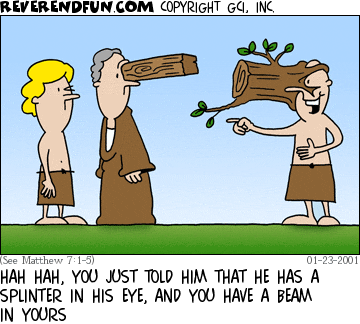
This is the key to the passage. We are called to help people (Philippians 1:9-10). But when we have our own wrongs, we can’t help others because it distorts our vision. Jesus used the image of the eye to illustrate a good point. If you have something in your eye, you can’t see good enough to help someone who has something in their eye. So if we will take care of our own eye, we will be able to see better to help someone else with their difficulty. This doesn’t mean you have to be perfect, just admit your fault and seek forgiveness. Also, remember, the eye is a very sensitive part of our body and reminds us that we must help people with tender care.
So how does this work? When a conflict, problem or fight arises between family members or friends, it often end up as an attack on each another rather than the problem. Attacking each other, while side-stepping the problem, will never solve the problem. It just makes the problem worse. Someone (I suggest you) must do a little self-judging – What did I do to create or make this problem worse? Then admit it. When you admit your fault in an argument, there is instant agreement because the other person has been blaming you all along. And it is amazing the atmosphere when someone admits, “I have wronged you. Will you forgive me?” Not always, but often the other person will admit their part in the fight. That is where reconciliation begins. You can’t see to help another person until you admit your own wrong.
A note of caution. Never blame the other person for your wrong actions. Even if you feel justified for your actions, words or attitude, blaming is not true repentance. Accept full responsibility for what you did and allow them to accept responsibility for what they did or said. Also, don’t forget to tackle the problem. Even if you ‘kiss and make-up’, the problem is still there. But now you can see it clearly and this is where you should ‘speak the truth in love’ so it doesn’t happen again.
Now a final parallel. The relationship between humanity (that means you!) and God is not good. Since Adam and Eve there has been a disconnect because of sin. Even though God didn’t do anything wrong in the disagreement, He made the first move. He sent His own Son, Jesus Christ, to accept the blame for your sin and die on the cross as your substitute for the penalty for sin. But just as in any relationship, forgiveness may be offered, but it must be accepted. Will you accept Jesus’ forgiveness?