
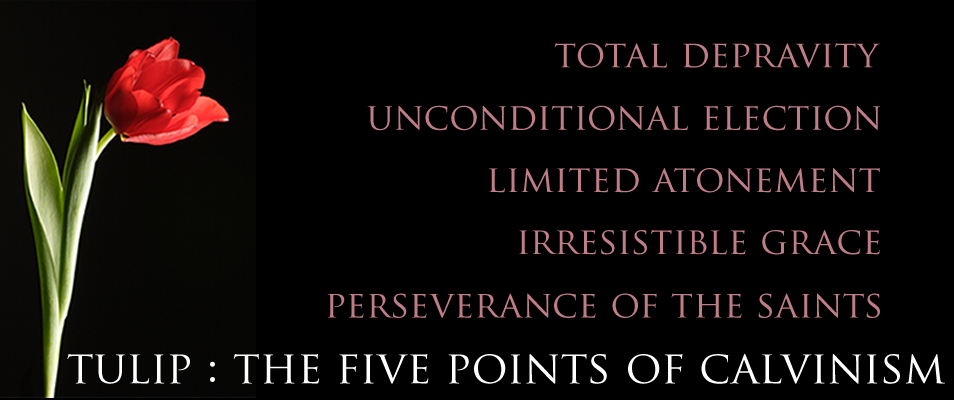
 Recently I was in conversation with some members of my congregation. We were trying to get a better handle on balancing God’s Sovereignty with Man’s Choice. The discussion eventually found its way to some beliefs known as Calvinism, named after John Calvin. Now, some of you may not even know what Calvinism is. That’s okay. It is currently a system of trying to understand God and His salvation. For those not acquainted, let me allow John Piper (a Calvinist) to summarize the beliefs in what has been made into an acrostic – TULIP (Check out Desiring God). It goes like this:
 T – Total Depravity – “total depravity means that our rebellion against God is total, everything we do in this rebellion is sin, our inability to submit to God or reform ourselves is total, and we are therefore totally deserving of eternal punishment.”
U – Unconditional Election – “Election refers to God’s choosing whom to save. It is unconditional in that there is no condition man must meet before God chooses to save him. Man is dead in trespasses and sins. So there is no condition he can meet before God chooses to save him from his deadness.”
L – Limited Atonement – “Christ died for all the sins of some men. That is, he died for the unbelief of the elect so that God’s punitive wrath is appeased toward them and his grace is free to draw them irresistibly out of darkness into his marvelous light.”
I – Irresistible Grace – “irresistible grace refers to the sovereign work of God to overcome the rebellion of our heart and bring us to faith in Christ so that we can be saved”
P – Perseverance of the saints – “the people of God will persevere to the end and not be lost. The foreknown are predestined, the predestined are called, the called are justified, and the justified are glorified. No one is lost from this group. To belong to this people is to be eternally secure.”
There could be a lot more explanation, but I think this gives you a general idea. I am in general agreement with three of the points of TULIP: total depravity, unconditional election, and perseverance of the saints. But the Bible presents a genuine desire on the part of God for the salvation of all humanity and a real offer of the gospel to everyone who hears it. So this means that “Limited Atonement” and “Irresistible Grace” are not part of my belief system.
I have found a better acronym that has helped me understand some of these deep doctrines – ROSES. It is based on what has been termed ‘Molinism,’ named after Luis de Molina. Here is how it is compared to TULIP by Kenneth Keathley in ‘Salvation and Sovereignty‘:
 R – Radical Depravity: “The old term, total depravity, gives the impression that fallen humanity always is as bad as it possibly can be. The new term, radical depravity, more correctly emphasizes that every aspect of our being is affected by the fall and renders us incapable of saving ourselves or even of wanting to be saved.”
O – Overcoming Grace: “The old term, irresistible grace, seems to imply that God saves a person against his will. The new term, overcoming grace, highlights that it is God’s persistent beckoning that overcomes our wicked obstinacy.”
S – Sovereign Election: “Often the term unconditional election is presented in such a way as to give the impression that those who die without receiving Christ did so because God never desired their salvation in the first place. The replacement label, sovereign election, affirms that God desires the salvation of all, yet accentuates that our salvation is not based on us choosing God but on God choosing us.”
E – Eternal Life: “The old term, perseverance of the saints, leads to the notion that a believer’s assurance is based on his ability to persevere rather than on the fact he is declared righteous in Christ. The purpose of the new term, eternal life, is to stress that believes enjoy a transformed life that is preserved and we are given a faith which will remain.”
S – Singular Redemption: “A particularly unfortunate concept, limited atonement, teaches that Christ died only for the elect and gives the impression that there is something lacking in the atonement. The label, singular redemption, emphasizes that Christ died sufficiently for every person, although efficiently only for those who believe.”
This answers some of the dilemmas that 5-point Calvinism faces: (1) Reconciling God’s sovereign election of individuals with His genuine desire for the salvation of all. (2) Adhering to a deterministic view of sovereignty without blaming God for the fall of Adam. (3 Adhering to limited atonement and irresistible grace while also affirming that the gospel is genuinely offered to everyone.
I have discovered that the Bible teaches that God exercises His sovereignty primarily through His omniscience (see Romans 8:29). He knows what free creatures will do in any given situation. In this way, God sovereignly controls all things, while allowing humans to be genuinely free.
Be careful not to allow a difference in these doctrines to separate you from good Christians. Recently I’ve discovered that in early Baptist history, Baptists differed greatly in their understanding God’s sovereignty and human free will. Good men were on both sides of the issue. Yet, in the 1700s there was only one group of Baptists because what united them was stronger than what could have divided them. However, in the centuries following, Baptists have split over doctrine, practice, or just about any difference. I am glad there is a difference of understanding among us. It causes me to get in the Bible and study it for myself. If you disagree with me, I hope it will prod you to open and study your Bible for truth. I hope you can teach me something I have not yet discovered.
Do you agree with my belief about some of the difficult doctrines within Calvinism?
Has this helped you see these issues more clearly?
Thank you very much. This is very helpful. Many of the ‘Calvinists’ with whom I sometimes converse seem to despise my assertion from the Scriptures “the atoning sacrifice of the Lord Jesus Christ is sufficient to safe all sinners and is efficient to save all who believe.” 1 (John 2:1, 2). I also find that many are very annoyed at the idea that God’s gift of His Son to deliver sinners from bondage to sin is a genuine offer to every sinner.
I also find an that calvinism in many groups has created pride in the hearts of many young men, when it should produce just the opposite. Knowledge puffs up but love edifies (1 Timothy 5:11). Thanks again.
For me I have always felt it better to let God define me rather than me define God.
Putting humanistic terms on Gods word is making it a relgion and not a relationship.
I agree. Many of the ‘terms’ we use are not in the Bible. They aren’t bad, but not Bible. Sometimes we pull from Scripture a doctrinal statement and then try to reinterpret the Bible based on that doctrinal statement. Just let the Bible stand in some of its mystery. I don’t think we’re meant to understand it all. But studying it is a worthwhile endeavor.