
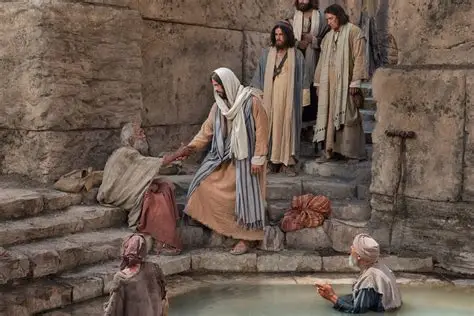
John 5:1-9
There is a question that cuts straight to the heart of human longing, one that sounds almost too simple on the surface but carries enormous weight underneath. It is the kind of question that, if you sit with it long enough, begins to expose things you did not even know were hiding inside you. The question is this: do you want to be made whole?
Not just better. Not just relieved of the immediate discomfort. Whole.
A Man at the Pool
In John chapter 5, there is a scene that is easy to read past if you are not paying attention. Jesus arrives at a pool called Bethesda in Jerusalem, a place where a great multitude of sick, blind, and lame people gathered. The belief was that when an angel stirred the water, the first person to step in would be healed. So people waited. Some had been waiting a very long time.
One man had been dealing with his condition for 38 years. Thirty-eight years of watching others get there first. Thirty-eight years of hoping, straining, falling short. When Jesus sees him and knows how long he has been in this state, he asks what seems like a strange question: “Wilt thou be made whole?” (John 5:6)
It sounds almost insensitive. Of course the man wants to be healed. Why would Jesus even ask? But Jesus was not being careless with his words. He was doing what he always does — going straight to the heart of the matter.
The Excuse We Do Not Recognize as an Excuse
Here is where the story gets uncomfortably personal. Jesus asks a yes or no question. The man’s answer is neither yes nor no. Instead, he explains why it has not happened yet. He has no one to carry him to the water in time. Someone always beats him to it. He is alone, overlooked, without resources.
Sound familiar?
There is something deeply human about answering a question about what we want with a list of reasons why we cannot have it. We do it constantly. God, I would love for my life to change, but you see, this is my situation. This is what I am dealing with. These are the people who have failed me. This is the hand I was dealt. The excuses are real. The circumstances are real. But the excuses, however valid they feel, are not the answer to the question.
What is even more revealing is that the man had a very specific idea about how his healing was supposed to happen. The pool. The stirring water. The right person to carry him. He had mapped out the method, and since that method kept failing, he had settled into a kind of resigned waiting. He was present at the place of healing without actually believing healing was coming.
How often do we do the same thing? We decide how God should fix our problem, and when he does not work within our preferred method, we conclude that nothing is happening. Meanwhile, Jesus is standing right in front of us asking a question we are too busy explaining ourselves to answer.
The Word “Whole” Changes Everything
It is worth pausing on the word Jesus uses. He does not ask if the man wants to walk. He does not ask if the man wants his body fixed. The word translated as “whole” or “well” in John 5:6 carries a meaning that is all-encompassing. It reaches beyond the physical into everything a person is — body, soul, and spirit.
Jesus was not just offering the man functioning legs. He was offering him something far greater. And the man, understandably, could only see as far as his most immediate problem.
This is the tension at the center of so much of our spiritual life. We bring God our most pressing complaint, the thing that is causing us the most pain right now, and we ask him to fix that specific thing. And God, in his wisdom and love, looks at us and sees everything we cannot see about ourselves and says, I want to do something so much bigger than what you are asking for.
There is a story of a man named Matt Ham who was diagnosed with cancer. He went through the devastation of that diagnosis and the brutal process of treatment, and somewhere in the middle of it all, he found God. He found Jesus. And he came out the other side saying that cancer was the best thing that ever happened to him. He described it as a beautiful gift wrapped in ugly paper. The thing he would have done anything to avoid became the doorway to everything that mattered most.
That is what wholeness looks like. It does not always arrive the way we planned.
Obedience Before the Miracle
When Jesus tells the man to rise, take up his bed, and walk, he is giving commands that make no logical sense for someone who has not been able to walk for nearly four decades. And yet the man does it. He does not argue. He does not ask for a moment to think it over. He simply acts on what he is told, and the miracle meets him in the middle of his obedience.
This is a pattern worth noticing. The miracle did not come before the obedience. It came through it.
Most of us know at least one thing God is asking us to do that we have not done yet. It may not seem related to the problem we want solved. It may feel small or inconvenient or even a little frightening. But the invitation is simple, even when it is not easy: just do the next right thing. Not the whole list. Not a complete life overhaul by Tuesday. Just the next thing.
A Life That Others Notice
When this man walked out of Bethesda carrying his mat, people noticed. How could they not? Thirty-eight years of seeing him in the same place, and now he was gone. Now he was walking.
When God genuinely transforms a life, it does not stay hidden. Attitudes shift. Patterns change. Something different begins to radiate outward, and the people closest to that person start to take notice even before they can name what they are seeing.
The question remains open. Do you want to be made whole — not just better, not just more comfortable, but truly, deeply whole? The answer you give, and what you do with it, may change everything.