
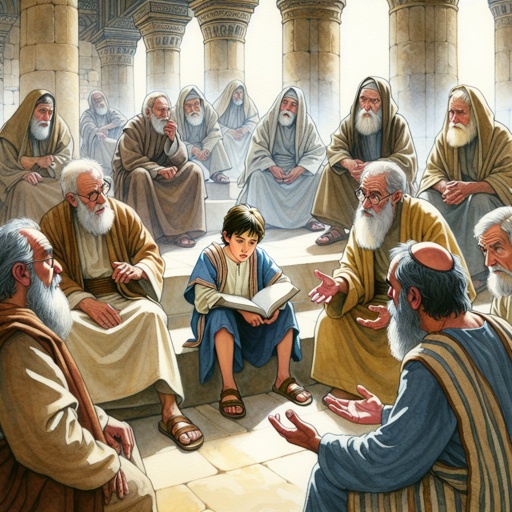
Luke 2:41-52
There’s something profound about a good question. It can stop us in our tracks, make us reconsider everything we thought we knew, and open doors we didn’t even know existed. Questions have the power to transform conversations, relationships, and even lives.
Consider this exchange: A young man approaches a successful businessman and asks, “What is the secret of your success?” The businessman replies simply, “Make good decisions.” The young man presses further, “How can I make good decisions?” The answer: “Wisdom.” One more question: “How can I get wisdom?” The businessman chuckles and says, “Make bad decisions.”
There’s uncomfortable truth in that answer. We learn through experience, often through failure. But that young man’s willingness to ask questions led him to valuable insight. He understood something crucial: the right questions lead to the right answers.
Jesus and the Art of Questions
Throughout the Gospels, Jesus asked approximately 226 questions. That’s nearly 15% of everything He said. For someone who came to teach the world, it’s remarkable how often He chose to ask rather than tell.
The very first recorded words of Jesus are actually questions. At age twelve, Jesus traveled with His parents to Jerusalem for Passover. After the feast, Mary and Joseph began their journey home, assuming Jesus was somewhere in their traveling party. After a full day’s journey, they realized He was missing.
Imagine the panic. They searched among relatives and friends. Nothing. They turned back to Jerusalem, and after three days of searching, they found Him in the temple, sitting among the religious teachers, listening to them and asking them questions.
The teachers were astonished. Here was a twelve-year-old boy whose understanding and answers amazed the most educated religious minds of the day. But notice what He was doing: He was asking questions, listening to their answers, and then providing His own insights.
When Mary and Joseph finally found Him, Mary expressed her frustration: “Son, why have you treated us this way? Your father and I have been searching for you in great distress.”
Jesus responded with two questions: “Why were you searching for me? Didn’t you know I had to be in my Father’s house?”
Why Did You Search for Me?
That first question cuts deep when we apply it to ourselves. Why are we searching for Jesus? What drives us to church, to prayer, to reading Scripture?
If we’re honest, much of our spiritual seeking is self-focused. We come to God with our problems. We want Him to fix our circumstances, smooth our paths, make our lives easier. We treat God like a divine problem-solver whose primary job is attending to our needs.
We want God to stop the world and pay attention to us—to make the traffic lights turn green when we’re running late, to give us that promotion, to heal that relationship. We want a genie in a bottle, not the sovereign God of the universe.
But Jesus reminds us: “I must be about my Father’s business.”
God is not primarily about our business. He’s about His business. And here’s the beautiful truth: when God’s business gets done, everyone benefits. When our business gets done, it often only serves us—and even then, incompletely and temporarily.
God’s purposes are higher, broader, and more lasting than our immediate concerns. When we align ourselves with what He’s doing rather than demanding He align with what we want, we find ourselves part of something far greater than our small ambitions.
Three Reasons Jesus Used Questions
Questions Reveal the Heart
The very first question in the Bible came from God Himself. After Adam and Eve sinned in the Garden of Eden, God walked in the garden and called out, “Adam, where are you?” The all-knowing God didn’t need information. He knew exactly where they were. The question was for their benefit, to help them realize they couldn’t hide from Him.
Later, Jesus asked His disciples, “Who do people say that I am?” After they answered, He pressed further: “But who do you say that I am?” That question gets to the core of faith. It’s one thing to know what others believe; it’s another to declare your own conviction.
Questions bypass our defenses and get straight to what we truly believe and value.
Questions Challenge Us to Think
Consider the story of King David and the prophet Nathan. David had committed adultery with Bathsheba and arranged for her husband’s murder to cover it up. Instead of directly confronting David, Nathan told him a story about a rich man who stole a poor man’s only lamb. David, outraged, declared the rich man deserved death. Nathan’s response: “You are the man.”
By asking David to judge the situation, Nathan made David think, engage his moral reasoning, and ultimately condemn himself. The question led to genuine repentance.
A good question doesn’t just fill the mind with information; it kindles a fire. It engages us, challenges us, and makes us active participants in discovering truth rather than passive recipients.
Questions Demand a Response
When someone asks you a question, silence is not neutral—it’s an answer in itself. “Will you marry me?” requires a response. Not answering is effectively saying no.
Jesus asked pointed questions that demanded responses:
- “Who do you say that I am?”
- “Why are you afraid?”
- “Do you want to be made whole?”
- “What does it profit someone to gain the whole world but lose their soul?”
- “Why do you call me Lord and don’t do what I say?”
- “Do you love me?”
Each of these questions requires us to examine ourselves and respond. We cannot remain neutral when confronted with such questions.
Two Questions for Today
Let these two questions settle over you:
First: Do you know Jesus Christ as your personal Lord and Savior?
Jesus died to pay for your sins. God gave His own Son to die a cruel death so you could be reconciled to Him. The response He asks for is simple trust—admitting you’re a sinner, believing in Jesus, and committing your life to Him. It’s not about earning salvation through good works but receiving it by grace through faith.
Second: Are you where you are for such a time as this?
This question comes from the story of Esther, whose uncle Mordecai asked her, “Who knows whether you have come to the kingdom for such a time as this?” Perhaps you are exactly where God wants you to be—in your job, your neighborhood, your current circumstances—so you can have an impact.
You are not an accident. You are not randomly floating through life. God has placed you where you are with divine purpose. Every moment is an opportunity to be used by Him.
The teachers in the temple were amazed at Jesus’ questions and answers. Perhaps it’s time we stop looking for all the answers and start asking the right questions—and allowing God to ask His questions of us.
What is He asking you today?