
Mark 4:35-41
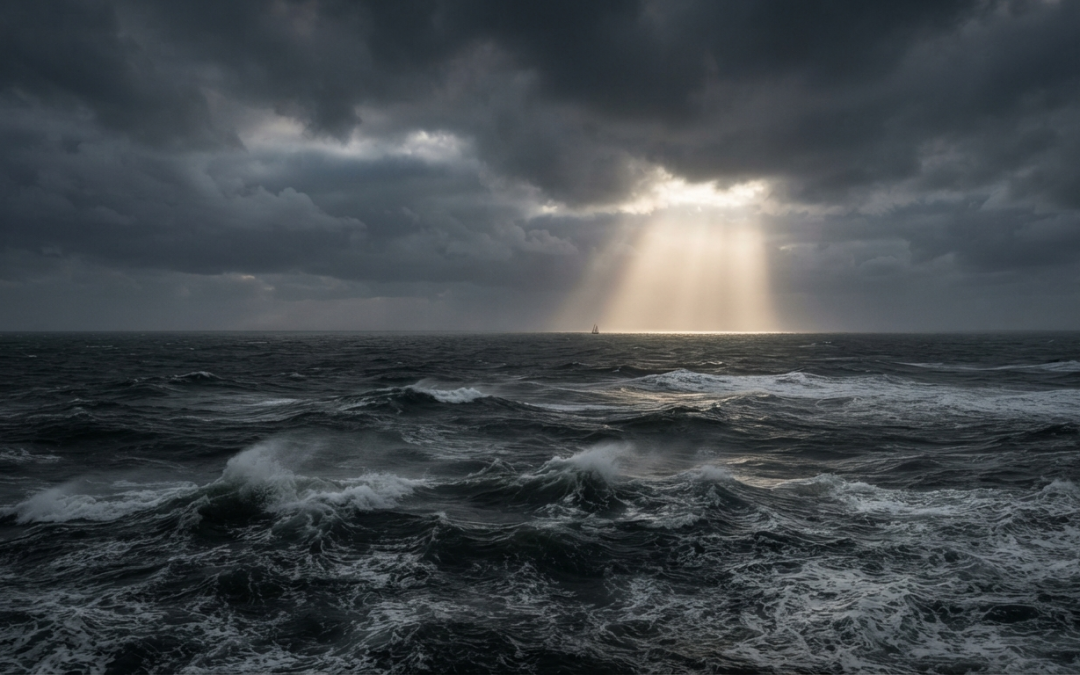
There is something uniquely terrifying about a storm you did not see coming. One moment the sky is clear, and the next, the wind is howling and the waves are crashing over the sides of the boat. Whether that storm is literal or figurative, most of us know the feeling. The ground shifts beneath us, our vision blurs, and we find ourselves gripping whatever we can just to stay upright.
The question is not whether the storms will come. They will. The real question is who is in the boat with you when they do.
The Storm Was Part of the Plan
In Mark chapter 4, Jesus tells his disciples to cross to the other side of the sea. He initiates the journey. He gives the command. And then, somewhere in the middle of that crossing, a violent storm rises up and threatens to swallow them whole.
This detail matters more than it might first appear. The disciples were not out on the water doing something reckless or disobedient. They were exactly where Jesus told them to be. And still, the storm came.
It is tempting to believe that if we live well, give generously, attend church faithfully, and try to follow God, we will somehow be insulated from hardship. Nobody says this out loud, but many of us quietly believe it. The story of the disciples on that stormy sea dismantles that assumption entirely. Sometimes storms come not in spite of following Jesus, but in the middle of following him.
The same is true of Job in the Old Testament. By any measure, Job was a righteous and prosperous man. His life reflected what many would consider the picture of divine blessing. And then, in what seemed like an instant, everything collapsed. His finances, his property, his children, his health. The book of Job makes clear that his suffering was not the result of a sinful life. If anything, it was a direct consequence of his righteousness. God allowed the storm because he trusted Job to come through it.
The storms of life are not always signs that something has gone wrong. Sometimes they are the very path God has chosen to reveal something that could not be seen any other way.
When God Seems to Be Sleeping
Here is where the story in Mark 4 becomes almost uncomfortably relatable. While the waves are crashing and the boat is filling with water and the disciples are terrified for their lives, Jesus is asleep in the back of the boat on a pillow.
Asleep.
The disciples wake him with a question that carries all the weight of human desperation: “Master, carest thou not that we perish?” It is the cry of people who believe in God but cannot understand why he is not acting. It is the prayer whispered in hospital waiting rooms, in the silence after a devastating diagnosis, in the hollow quiet of a house that used to be full of laughter.
Does he not care?
Andrew Brunson, an American pastor who spent two years in a Turkish prison on false charges, wrestled with this same question. After his release, he reflected on what sustained him through those dark years. His words cut straight to the heart of the matter: “God doesn’t always answer the why questions.”
That is not the answer we want. We want explanations. We want timelines. We want God to justify his silence. But Brunson’s experience, like that of the disciples, points to something deeper. God’s presence is more important than our immediate deliverance. Even when he seems absent, even when the silence stretches on far longer than we think we can bear, he has not left the boat.
The disciples thought Jesus was absent from their crisis because he was not responding to it on their schedule. But he was right there. He had been there the whole time. And when the moment came, he rose and spoke.
Peace Be Still
What happened next is one of the most staggering moments in all of Scripture. Jesus stood up, rebuked the wind, and said to the sea, “Peace, be still.” And the wind stopped. The waves flattened. The sea went completely calm.
Then he turned to his disciples and asked, “Why are ye so fearful? How is it that ye have no faith?”
Notice the word he used. Not afraid, but so afraid. Fear in the face of a genuine storm is a natural and reasonable human response. When the doctor delivers frightening news, when a marriage is fracturing, when a job disappears, when a child is in danger, fear arrives uninvited and without apology. That is not the problem. The problem is fear that crowds out faith entirely. Fear that looks at Jesus and asks, “Do you not care?” as though the answer might actually be no.
The disciples had seen enough of Jesus to know better. And yet in the chaos of the storm, they forgot. That is one of the most human things about this story. They forgot who was in the boat with them.
Charles Spurgeon, who battled severe depression throughout his life and ministry, wrote something that speaks directly to this tension: “God is too good to be unkind, and he is too wise to be mistaken. When we cannot trace his hand, we must trust his heart.”
Hanging On Through the Breaking Point
There is a phenomenon that happens when a jet aircraft approaches the speed of sound. The instrument panels shake. The pilot’s vision blurs. The entire aircraft vibrates as though it is about to come apart. And then, the moment the jet breaks through that barrier, everything goes calm. The shaking stops. The instruments settle. A strange and sudden peace takes over.
There are moments in life that feel exactly like that threshold. Everything is rattling. Nothing makes sense. It feels like one more degree of pressure will cause the whole thing to collapse. The temptation in that moment is to pull back, to abandon course, to give up just before the breakthrough.
Philippians 4 describes a peace that surpasses all understanding, a calm that does not depend on the storm being gone but on the presence of the one who commands it. That peace is available even now, in whatever you are facing.
The storm may not disappear today. But the one who spoke to wind and water and watched them obey is still in the boat. Hold on.