
Hebrews 6:13-20
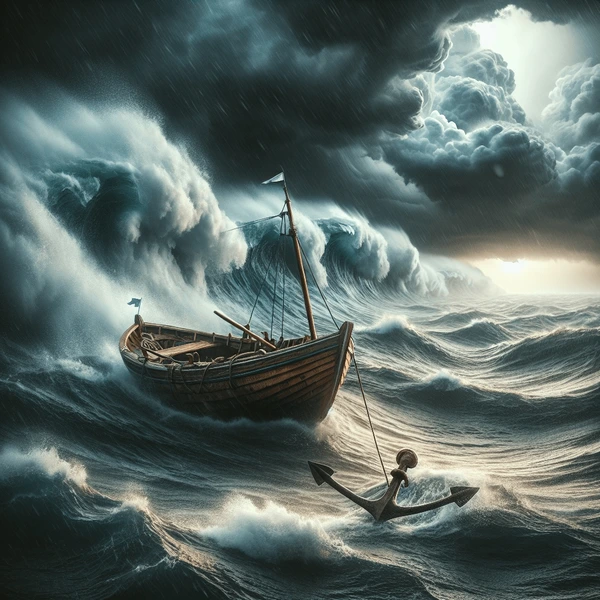
Life has a way of throwing storms at us when we least expect them. Financial troubles crash like waves against our stability. Health crises blow through like hurricanes, leaving devastation in their wake. Family conflicts swirl around us like tornadoes, threatening to uproot everything we’ve built. The question isn’t whether storms will come—it’s what will hold us steady when they do.
The Power of an Unchanging Promise
There’s something profoundly comforting about a promise that doesn’t shift with circumstances. In Hebrews chapter 6, we discover that God’s promises stand firm regardless of what we’re facing. When life feels uncertain and everything around us seems to be falling apart, God’s Word remains unchanging.
Consider Abraham’s story. God made him an incredible promise: “I will bless you and multiply you.” Yet years passed. Abraham aged. His wife Sarah grew old. Still no child. How could he become the father of nations when he couldn’t even father one son? The promise seemed impossible, yet God’s word proved true. After patient endurance, Abraham received what God had promised—not because circumstances looked favorable, but because God cannot lie.
This same principle applies to every promise God has made to us. Jesus said He’s coming back—and He will, even though it’s been two thousand years. Scripture declares that whoever calls on the name of the Lord will be saved—and that promise holds, regardless of our past failures or present struggles. We’re told that all things work together for good for those who love God—even when we’re in the middle of tragedy and can’t see how anything good could possibly emerge.
Double Assurance for Our Doubts
God understands our human tendency to doubt. That’s why He didn’t just make promises—He confirmed them with an oath. When people make important commitments, they swear by something greater than themselves. We place our hand on a Bible in court. We invoke God’s name to reinforce our truthfulness. But God had no one greater to swear by, so He swore by Himself.
This double assurance—both God’s promise and His oath—gives us unshakeable confidence. These are two immutable, unchangeable realities. God cannot lie, and God will not break His oath. When both are stacked together, we have absolute certainty that what God has said will come to pass.
Think about it: even when our feelings tell us God has abandoned us, even when circumstances scream that we’re alone, God’s double assurance stands firm. Our emotions rise and fall like waves, but His promises remain steady as bedrock.
Faith Before the Table Is Full
True faith means thanking God while the table is still empty. It means trusting His provision before we see it materialize. It means believing His promises when everything around us contradicts them.
There’s a powerful story about a youth group that went to camp without quite enough money for food. They sat down at a restaurant, prayed, and suddenly the staff offered them pizzas that another group had ordered but never picked up. The next morning, a delivery truck showed up with milk and food from a company whose refrigerator had broken down. Coincidence? Or God fulfilling His promise to provide?
Faith doesn’t wait for the miracle before saying “thank you.” Faith thanks God in advance because His promises are that reliable.
The Anchor That Holds
Hebrews 6:19 gives us one of Scripture’s most beautiful images: “Which hope we have as an anchor of the soul, both sure and steadfast.” Our hope isn’t wishful thinking—it’s an anchor. But unlike a ship’s anchor that drops down into murky waters, our spiritual anchor reaches up into heaven itself.
Behind the veil in the ancient temple was the Holy of Holies, where God’s presence dwelt. Once a year, the high priest entered with blood to atone for the nation’s sins. But our anchor reaches into the heavenly Holy of Holies, where Jesus sits—not once a year, but forever. He’s not making repeated sacrifices; He sat down because His work is finished. He’s there permanently, securing our hope.
When storms rage, this anchor doesn’t stop the waves. It doesn’t calm the wind or prevent the lightning. But it keeps the ship from drifting away. It holds us steady when everything else is chaos.
An old fisherman once survived a massive storm that destroyed every other boat at the pier. When reporters asked how his small vessel remained untouched, he had a simple answer: “The anchor held.”
Where Is Your Anchor?
Everyone anchors their life to something. For some, it’s their bank account—they’re desperately trying to build financial security. For others, it’s their health—they’re hoping their bodies won’t fail them. Many anchor themselves to family, investing everything in those relationships.
These aren’t bad things. But they’re insufficient anchors for life’s worst storms. Money disappears. Health fails. Families fracture. When the truly devastating storms hit—the ones that knock you to your knees and make you wonder if you’ll survive—you need an anchor that cannot break.
Jesus told a parable about two builders. One built his house on rock; the other on sand. The same storm hit both houses. The difference wasn’t the storm’s intensity—it was the foundation. The house on rock stood firm. The house on sand fell flat.
The storms are coming. They come for everyone. The question is: what’s your foundation? Where’s your anchor?
Holding On Through the Storm
If you’ve never trusted Jesus as your Savior, there’s no better time than now. It’s as simple as ABC: Admit you’re a sinner and need Him. Believe in Jesus and what He did for you on the cross. Commit your life to Him, turning from sin and turning to Christ. “Whosoever shall call on the name of the Lord shall be saved”—no conditions, no exceptions.
If you already know Jesus but you’re in a storm right now, hang on. Tighten your grip on that anchor. Read your Bible. Pray. Spend time with other believers. Don’t let the waves convince you that the anchor isn’t holding—it is.
And if life is calm right now, use this time wisely. Strengthen your spiritual life. Build your relationship with God. Because the calm won’t last forever, and you want to be prepared when the next storm arrives.
There’s an old song with profound truth: “The anchor holds though the ship is battered. The anchor holds though the sails are torn. I have fallen on my knees as I faced the raging seas. The anchor holds in spite of the storm.”
In the darkest nights and fiercest storms, God proves His love and faithfulness. The anchor holds—not because we’re strong enough to hang on, but because He’s strong enough to hold us.